


How Does Mitochondrial Health Influence Physical Performance?
You can train consistently, eat well, get enough sleep, and still wonder:
“Why don’t I have the energy I used to?”
Maybe your usual workout suddenly feels harder. You get tired sooner than expected. Your muscles feel heavy after exercise. You need more time to recover. Or you simply don’t have the same physical stamina you once had. There are many possible reasons for these changes. But one part of the body deserves a closer look when we talk about energy and physical performance:
Your mitochondria.
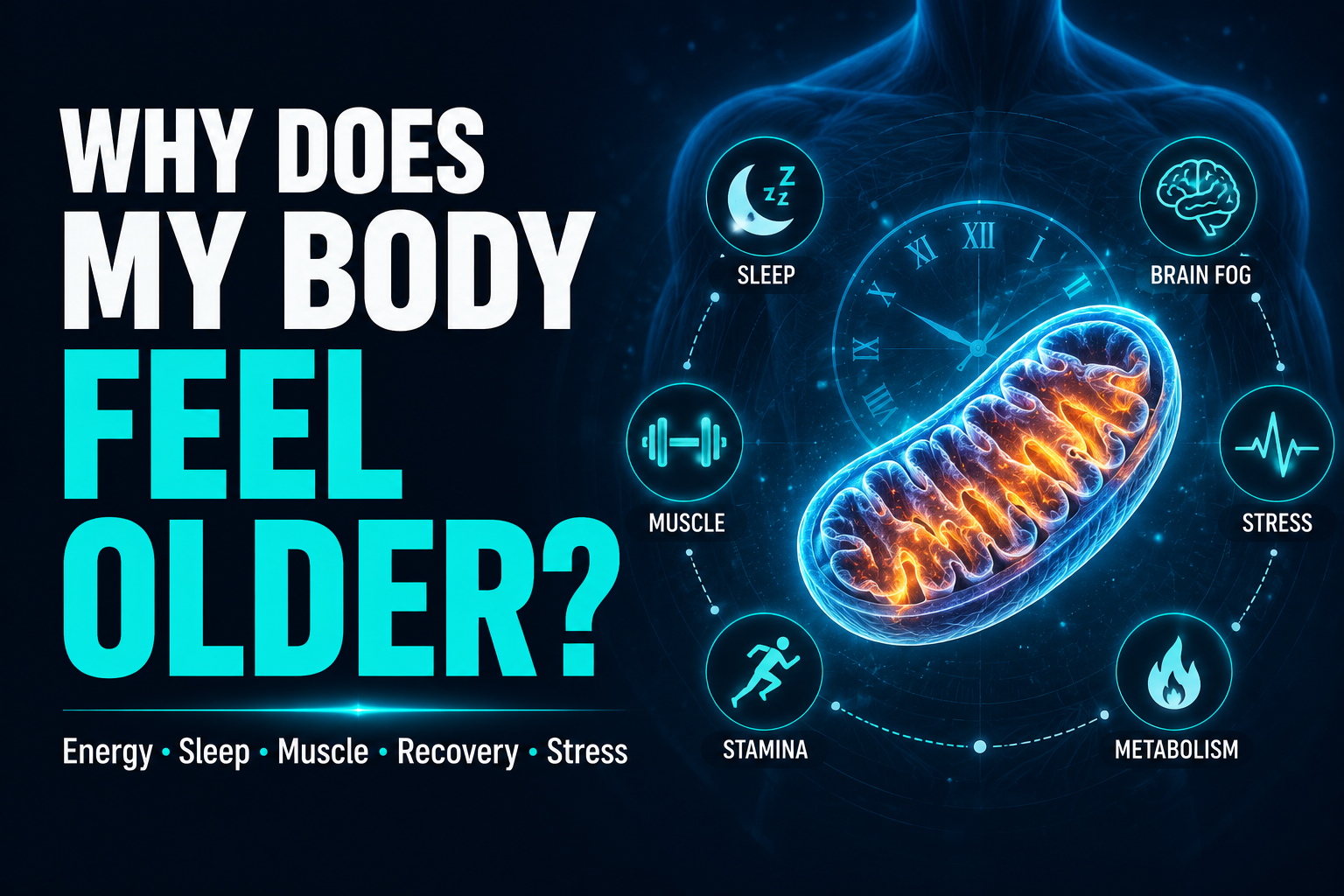
Often called the “powerhouses of the cell,” mitochondria are tiny structures inside your cells that help convert nutrients into usable energy. Your muscles depend heavily on this energy system, especially when you exercise.
But mitochondrial health is about more than simply making energy.
Mitochondria are dynamic structures involved in energy metabolism, cellular signaling, calcium regulation, redox balance, and other processes that influence how cells respond to stress and exercise.
What Are Mitochondria and Why Do Your Muscles Need Them?
Every movement requires energy. Walking across a room. Climbing stairs. Lifting weights. Running. Cycling. Even maintaining your posture requires your muscles to use energy.
One of the most important energy-carrying molecules in your cells is ATP, or adenosine triphosphate. Your body continually produces and uses ATP. Mitochondria are central to the process of producing ATP through oxidative metabolism.
When physical activity continues for longer periods, your muscles increasingly depend on aerobic energy production. That makes mitochondrial function particularly important for activities such as walking, running, swimming, cycling, hiking, and other forms of endurance exercise.
This is why mitochondrial health and physical performance are closely connected. But there is an important distinction, Mitochondria are part of the performance equation—not the entire equation.
Your cardiovascular system, lungs, blood flow, nervous system, muscle mass, hormones, nutrition, sleep, training status, and psychological state also influence performance.
The Mitochondria–Performance Connection
Think of your muscles as an engine. Food provides the raw materials. Oxygen helps support aerobic energy production. Your cardiovascular system delivers oxygen and nutrients.
Your muscles use that energy to produce movement. And your mitochondria are central to converting available fuel into usable cellular energy. When your muscles need sustained energy, mitochondrial oxidative capacity becomes particularly important.
Research on skeletal muscle shows that endurance training can increase mitochondrial content and alter mitochondrial function. These adaptations are especially relevant to endurance capacity.
That helps explain why someone who gradually builds aerobic fitness can eventually perform an activity for longer before feeling exhausted. The body becomes better at meeting the energy demands being placed on it.
How Does Mitochondrial Health Influence Physical Performance?
It Helps Support Sustained Energy Production
One of the clearest connections is endurance. During prolonged activity, your muscles need a continuous supply of ATP. Mitochondria help support this process through oxidative phosphorylation.
If mitochondrial oxidative capacity improves, your muscles can become better adapted to sustained aerobic work. This is one reason endurance training can improve your ability to exercise for longer periods.
It isn’t because your body suddenly discovers a secret energy source. Your cells become better adapted to producing and using energy under the demands of exercise.
Healthy Mitochondria Support Muscle Endurance
Imagine two people walking uphill at the same pace. Their muscles are doing similar work. But their ability to sustain that work can be very different. Muscle endurance depends on several factors, including oxygen delivery, cardiovascular fitness, muscle composition, nervous-system function, fuel availability, and mitochondrial capacity.
Mitochondria help muscles maintain aerobic energy production during sustained activity. When mitochondrial function is impaired because of a genuine mitochondrial disorder, exercise intolerance and premature muscle fatigue can occur.
This is very different from ordinary tiredness. Most people who feel tired after exercise do not have a mitochondrial disease. That distinction matters.
Mitochondria Adapt to Exercise
One of the most fascinating things about mitochondria is that they are not static. They adapt. Exercise provides a biological signal. Your muscles experience increased energy demand. That stress activates signaling pathways involved in mitochondrial adaptation.
Over time, training can influence:
- Mitochondrial content
- Mitochondrial enzymes
- Oxidative capacity
- Mitochondrial respiration
- Cellular energy metabolism
- Muscle endurance
A 2025 systematic review and meta-analysis found that endurance exercise significantly increased PGC-1α, a key regulator associated with mitochondrial biogenesis, although the studies showed substantial variation in their results. Exercise tells your cells they need to become better prepared for future energy demands.
Endurance Training and Strength Training Send Different Signals
Endurance Training
Not all exercise affects mitochondria in exactly the same way.
Activities such as:
- Brisk walking
- Jogging
- Cycling
- Swimming
- Hiking
- Rowing
place repeated demands on aerobic energy production. These forms of training are strongly associated with mitochondrial adaptations in skeletal muscle.
Resistance training
Strength training has a different primary purpose.
It helps stimulate:
- Muscle strength
- Muscle size
- Neuromuscular adaptation
- Bone loading
- Functional capacity
But resistance training also influences mitochondrial biology. A recent systematic review of mitochondrial myopathy studies found improvements in both mitochondrial enzyme activity and muscle strength with exercise interventions, although the evidence base remains relatively small.
This is one reason a balanced exercise program can be more useful than focusing on only one type of movement.
Mitochondrial Health Can Influence Recovery
Exercise creates stress. That’s part of why training works. But your body also needs to recover from that stress. Mitochondria participate in several processes involved in cellular metabolism and adaptation.
After exercise, your body has to restore energy stores, repair and remodel tissues, regulate cellular stress, and prepare for the next demand. Mitochondrial adaptations are therefore part of the broader process by which muscle responds to repeated exercise. But again, mitochondrial function is not the only determinant of recovery.
Sleep, protein and overall nutrition, hydration, training volume, stress, age, health status, and the type of exercise all matter.
Mitochondria Help Your Body Handle Higher Energy Demands
Think about what happens when you move from walking to running. Your muscles suddenly need more energy.
Your heart beats faster.
Your breathing increases.
More oxygen reaches your working muscles.
Your cells increase their energy production.
Mitochondria help support this increased demand.
As your fitness improves, your body becomes better at handling these demands.
This is one reason physical training can make everyday activities feel easier.
You don’t necessarily need more effort.
Your body becomes more efficient at meeting the effort required.
What Happens When Mitochondrial Function Is Impaired?
This is where it is important to separate normal physiology from disease. Primary mitochondrial disorders are rare conditions that can interfere with cellular energy production.
In mitochondrial myopathies, common symptoms can include:
- Exercise intolerance
- Premature muscle fatigue
- Muscle weakness
- Exercise-related muscle pain
- Reduced physical capacity
Most fatigue has many possible explanations.
A person who becomes tired after a workout may simply have trained harder than usual, slept poorly, eaten inadequately, or not yet developed the conditioning required for that activity.
Mitochondrial Health vs. Mitochondrial Disease
|
|
|
|
|
|
|
|
|
|
|
|
|
|
|
|
|
|
This distinction is extremely important. Feeling tired does not automatically mean your mitochondria are damaged.
What Can Support Healthy Mitochondrial Function?
There is no single food, supplement, or “mitochondrial hack” that guarantees optimal mitochondrial health.
Your mitochondria respond to your overall environment.
1. Regular Physical Activity
Exercise is one of the strongest and most consistently studied stimuli for mitochondrial adaptation.
Current CDC guidance recommends at least 150 minutes of moderate-intensity aerobic activity each week plus muscle-strengthening activity on at least two days.
If you’re currently inactive, however, you don’t need to jump straight to 150 minutes.
Start where you are.
A short walk is still movement.
A few minutes of activity is better than none.
And training should be appropriate for your current fitness and health status.
2. Don’t Ignore Recovery
More exercise isn’t automatically better.
Your body needs time to adapt to training.
Recovery includes:
- Adequate sleep
- Appropriate nutrition
- Rest days
- Hydration
- Managing training load
- Managing chronic stress
If you continually increase training while neglecting recovery, you can end up feeling more exhausted rather than fitter.
3. Give Your Body the Nutrients It Needs
Mitochondrial energy production relies on complex biochemical pathways that require numerous nutrients. A varied, nutrient-dense diet helps provide the raw materials required for normal cellular function. Rather than focusing on one “superfood,” think about the overall pattern.
Include a variety of:
- Vegetables
- Fruits
- Protein-rich foods
- Whole grains and other fiber-rich carbohydrates
- Nuts and seeds
- Healthy fats
- Nutrient-dense whole foods
Individual nutritional needs vary, particularly if someone has a medical condition or deficiency.
4. Support Metabolic Health
Mitochondria don’t operate independently. They sit inside a much larger metabolic system. Blood glucose regulation, insulin sensitivity, nutrient availability, body composition, physical activity, sleep, and stress all influence the environment in which your cells operate.
This is why a systems-based approach can be more useful than treating mitochondrial function as a completely separate issue.
5. Don’t Overlook Sleep
Your body doesn’t build fitness while you’re exercising alone. Adaptation happens during recovery too. Poor sleep can affect exercise performance, motivation, recovery, appetite, and metabolic regulation. If you’re training hard but sleeping poorly, the answer may not be another workout. It may be better recovery.
What Does “Poor Mitochondrial Health” Actually Mean?
This phrase is used frequently online, but it can mean very different things.
Someone may use it to describe:
- Low energy
- Poor exercise tolerance
- Metabolic dysfunction
- Aging-related changes
- Oxidative stress
- Mitochondrial dysfunction associated with disease
These are not interchangeable.
There is also no single everyday symptom that proves someone has poor mitochondrial function. A responsible approach looks at the person’s overall health picture.
How Can You Tell If Your Physical Performance Is Changing?
Don’t only look at the number on a scale. Pay attention to functional changes.
Endurance
Can you walk, cycle, swim, or run for longer than you could a few months ago?
Recovery
How quickly do you feel ready for your next workout?
Strength
Are everyday tasks becoming easier?
Exercise tolerance
Can you complete the same workout without feeling unusually exhausted?
Heart and breathing response
Does your usual activity feel easier at the same intensity?
Energy outside the gym
Do you have enough energy left for work, family, hobbies, and everyday life?
These practical measures can tell you more about physical function than chasing a single “energy score.”
A Simple Mitochondrial Health Framework
|
|
|
|
|
|
|
|
|
|
|
|
|
|
|
|
|
|
|
|
|
|
|
|
|
|
|
|
|
|
|
|
Can You “Boost” Your Mitochondria?
This is where you should be skeptical of marketing.
You will find products online promising to:
- “Supercharge” mitochondria
- “Activate” cellular energy
- “Repair” mitochondria
- Reverse fatigue overnight
- Dramatically increase ATP
Some nutrients and compounds have been studied for their effects on mitochondrial biology, but research quality and clinical relevance vary widely. A supplement is not a substitute for exercise, sleep, nutrition, and appropriate medical care.
Exercise itself has strong evidence as a stimulus for mitochondrial adaptation. Recent reviews continue to examine how exercise type, intensity, volume, and duration influence these adaptations.
The WildHeart Wellness Perspective
At WildHeart Wellness, mitochondrial health can be understood as one part of a much larger system. Your cells don’t exist in isolation.
Your mitochondrial function interacts with your:
Metabolism.
Nutrition.
Movement.
Sleep.
Stress response.
Recovery.
Gut health.
Overall wellness.
That is why chasing one marker or one supplement may not tell the whole story. A more meaningful approach is to understand the patterns that influence how your body produces, uses, and recovers from energy demands.
Your Energy Has a Story. Let’s Understand It.
If your physical stamina has changed, your workouts no longer feel the way they used to, or you’re constantly running out of energy, don’t simply push harder. Start by understanding what may be driving the change.
Frequently Asked Questions
Does mitochondrial health affect physical performance?
Yes. Mitochondria are central to cellular energy production, particularly during sustained aerobic activity. Research shows that exercise training can increase mitochondrial content and alter mitochondrial function in skeletal muscle, supporting adaptations related to endurance.
What do mitochondria do during exercise?
Mitochondria help produce ATP through oxidative metabolism. During prolonged exercise, this aerobic energy system becomes particularly important for meeting the muscles’ ongoing energy demands.
Can exercise improve mitochondrial function?
Yes. Exercise is a powerful stimulus for mitochondrial adaptation. Endurance exercise has been shown to increase markers of mitochondrial biogenesis and mitochondrial function, although the response depends on factors such as training type, intensity, duration, volume, and individual characteristics.
Does having more mitochondria automatically mean better athletic performance?
Not necessarily. Mitochondrial content and function are important pieces of endurance physiology, but performance also depends on oxygen delivery, cardiovascular fitness, muscle characteristics, nervous-system function, training status, nutrition, and other factors. Recent research suggests that the relationship between mitochondrial adaptations and performance is complex rather than one-to-one.
How does mitochondrial health affect endurance?
Mitochondria help muscles sustain aerobic energy production. Better mitochondrial oxidative capacity can support the ability to maintain prolonged activity, although endurance also depends on cardiovascular and muscular factors beyond mitochondria alone.
Can poor mitochondrial function cause muscle fatigue?
Clinically significant mitochondrial disorders can cause exercise intolerance and muscle fatigue because impaired oxidative phosphorylation affects energy production in skeletal muscle. However, everyday fatigue should not automatically be attributed to mitochondrial dysfunction.
Does strength training help mitochondria?
Yes. Resistance training can influence mitochondrial adaptations while primarily improving strength and muscle function. Evidence in people with mitochondrial myopathy suggests that resistance exercise can improve muscle strength and some mitochondrial measures, although the evidence base remains smaller than the broader exercise literature.
How much exercise do I need to support mitochondrial health?
There is no single mitochondrial-specific exercise prescription that applies to everyone. For general health, CDC guidance recommends at least 150 minutes of moderate-intensity aerobic activity per week and muscle-strengthening activity on at least two days per week for adults.
Can food improve mitochondrial health?
Nutrition provides the energy and nutrients required for normal cellular metabolism, but there is no single food that guarantees better mitochondrial function. A balanced, nutrient-dense dietary pattern is more meaningful than relying on one “mitochondrial superfood.”
Do I need mitochondrial supplements?
Not necessarily. Supplements marketed for mitochondrial health vary considerably in evidence and purpose. Whether a supplement is appropriate depends on the individual and should not replace a balanced diet, exercise, sleep, or appropriate medical care.
How do I know if my mitochondria are unhealthy?
You generally cannot determine mitochondrial dysfunction from tiredness alone. Clinically significant mitochondrial disorders require appropriate medical assessment, which may include a detailed history, physical examination, laboratory testing, exercise testing, genetic testing, or other specialized investigations depending on the situation.
Why am I tired during exercise even though I exercise regularly?
Many factors can contribute, including insufficient recovery, poor sleep, inadequate nutrition, dehydration, excessive training load, illness, medications, stress, or an underlying medical condition. If the change is persistent or unusual for you, professional evaluation is appropriate.
The Bottom Line
Your mitochondria are small, but their role in physical performance is anything but small.
They help your cells produce usable energy. They adapt to exercise. They support the demands placed on working muscles. And their function is closely connected to the body’s ability to sustain physical activity.
But mitochondrial health isn’t a magic explanation for every energy problem. Better physical performance comes from a whole-body equation.
Move. Fuel. Recover. Adapt.
Give your body the conditions it needs to respond to the demands you place on it. And if your energy, stamina, or recovery has changed in a way you can’t explain, don’t simply assume you need to train harder.
Look deeper. Your body is always adapting. The question is: what is it adapting to?
Explore your health. Understand your patterns. Build a stronger foundation for lasting vitality.